
Commercial Roofing Services
ROOFING SERVICES
Commercial Roof Leak Repair
Emergency Commercial Roof Repair
Commercial Roof Repair
Commercial Roof Inspection
Commercial Roof Maintenance
Commercial Roof Coating
Commercial Roof Replacement
ROOF SYSTEMS
TPO Roofing
EPDM Roofing
PVC Roofing
Modified Bitumen Roofing
Standing Seam Metal Roofing
PROPERTY TYPES
Warehouse Roofing
Distribution Center Roofing
Office Building Roofing
School Roofing
INDUSTRIES
DAMAGE REPAIR
CAPABILITIES
MANUFACTURERS
SERVICE AREAS
Commercial Roof Edge Metal and Gutters in Joliet, IL
Commercial Roofing Services
Repair commercial coping, edge metal, gutters and downspouts in Joliet with secure terminations and drainage details coordinated to the roof membrane.
Commercial Roof Edge Metal and Gutters
A parapet cap that has shifted can admit water behind the roof flashing before a leak appears inside. We inspect coping, edge metal, cleats, seams, gutters and downspouts as a connected perimeter system. The roof membrane's termination, the metal attachment and the drainage path all need to work together. Joliet has a logistics and manufacturing base with multiple business and industrial parks, so roof work often has to fit active loading and equipment schedules. We document loose seams, open joints, damaged fasteners and gutter conditions, then identify whether the repair is isolated or extends along a longer edge. The walk also checks how water reaches the perimeter. A July 2023 tornado moved from Minooka through Shorewood to Joliet, with damaging hail and wind in the I-80 and Kankakee River Valley region. That event can prompt a perimeter review, but only the field inspection establishes which details were affected. If the membrane termination is involved, roof repair can be coordinated with the metal correction so the new edge does not cover an unresolved leak path.
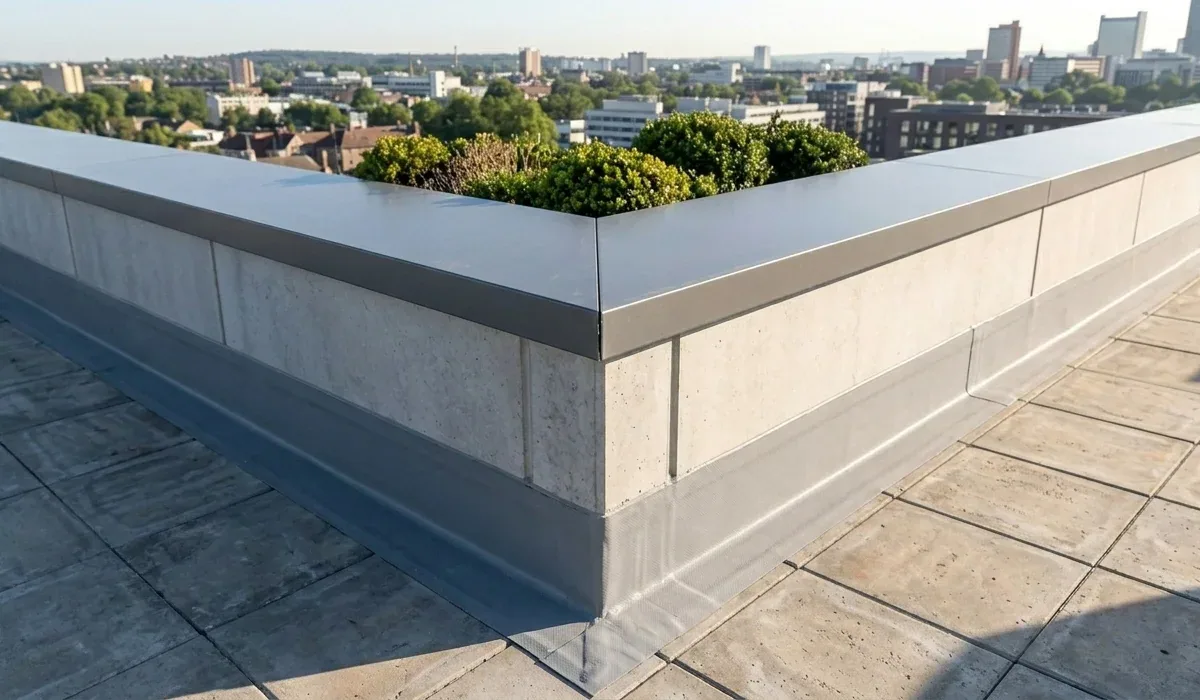
Coping, Cleats, and Termination Bars
At a parapet, we check the coping joints, cleats, splice plates, fasteners and wall-side termination. A loose cap can move under wind pressure or allow water to reach the wall assembly. At a low-slope edge, we inspect the metal profile, attachment, membrane turn-up and termination bar. The repair needs a secure substrate and a detail that can shed water without leaving exposed membrane or open laps. We record the edge by roof section and note where corners, changes in height or roof additions alter the connection. The July 2023 tornado track ran from Minooka through Shorewood to Joliet, with hail and wind impacts in the wider I-80 and Kankakee River Valley region. Those events support checking perimeter details, not assuming damage at every building. If the roof field or flashing is involved, a wind damage inspection can document the adjacent membrane and transition.
The existing assembly affects the replacement detail. We check the wall substrate, membrane turn-up and available fastener line before choosing how the new coping or edge is secured. At inside and outside corners, field-cut pieces and splice locations need a clean fit so movement does not pull a joint open. We identify any substrate repair and protection required before the metal is installed. If a parapet has several roof elevations meeting at one corner, the crew marks which section closes first and where the tie-in remains exposed during the shift. This avoids leaving an unfinished edge at the end of the work window.
Gutters, Downspouts, and Discharge
A gutter that holds debris or has a separated joint can send water behind fascia or toward a wall. We inspect slope, hangers, seams, outlets and downspout connections, then trace where water discharges. A roof scupper must be clear and flashed so it does not bypass the drainage route. The scope separates roof-side metal work from a damaged storm drain or underground connection that needs another trade. Joliet receives regular precipitation and snow, and the freeze-thaw cycle can expose a weak gutter seam or blocked outlet. We document the observed connection and note any discharge point that cannot be verified from the roof. If water remains on the membrane before reaching the edge, drainage corrections may be needed as well. This helps avoid replacing the visible gutter while leaving the upstream slope or scupper condition unchanged.
Gutter replacement also calls for a review of attachment and discharge. We note whether hangers are secure, whether a joint has separated, and whether the outlet directs water to a known drain point. Debris removal may resolve a slow flow, but a crushed downspout or disconnected leader needs a different trade. We list those items separately so the roofing scope does not imply that underground drainage has been repaired. Where the system changes, the owner can review the discharge path with the project team before closing fascia or edge metal.
Metal Work and Membrane Handoff
Metal replacement can open the roof edge, so the sequence needs a clear dry-in point and a membrane installer assigned to close the transition. We coordinate removal lengths, new cleat or fastener attachment, splice locations and final termination with the general contractor. Roof access, lift placement and debris lowering should also be planned around occupied areas and active loading. The Elwood/Joliet freight subregion is generally bounded by I-80, US 52, Hoff Road and I-55. That context can affect travel and staging at some projects, while the property's specific access route controls the plan. We photograph the assembly before removal and the completed edge after installation. If insulation or deck is exposed, the condition is recorded before closure. A broader replacement scope can include perimeter details when the membrane field is also at the end of service life. For selected systems, standing-seam metal transitions need a separate panel and flashing review.
Perimeter Condition Record
We finish with photographs of corners, joints, downspout connections and membrane terminations, then list any edge area not included in the repair. The record identifies metal type where known and notes fasteners or sealant used in the completed detail. Maintenance staff can use it to recheck the same locations after severe weather or seasonal temperature changes. Illinois Route 53 follows Historic Route 66 from I-80 in Joliet to the county line in Godley. Where travel and lift access are planned along that corridor, we confirm the actual property entry and staging zone. We keep that access note separate from the roof condition itself. A maintenance program can revisit gutters and edge joints, while condition reporting can carry the findings into a larger capital plan. For work in Joliet, we coordinate the roof walk and access route with the facility's operating schedule.
After the next weather event, a short perimeter review can check those same joints and outlets against the completed photos. That comparison helps identify whether the repair remains secure or a new condition has appeared at an adjacent edge.
Commercial Roofing Questions
What signs indicate loose coping or edge metal?
Look for shifted caps, open joints, separated splice plates, loose fasteners, rust or a termination that has lifted from the roof. We inspect the metal and adjacent membrane together, then mark the repair length and any substrate work required.
Can a new gutter stop water entering at the roof edge?
The gutter is the cause only when water enters at that edge. We trace the membrane termination, fascia, gutter seams and downspout discharge before replacing material. A blocked scupper or failed flashing upstream may need separate correction.
Does wind damage require replacing the full perimeter?
The inspection determines whether movement is isolated or continues along a connected edge. We check corners, cleats, fasteners and membrane terminations, then document the affected locations. A broader replacement is considered only when field conditions support that scope.
How do you coordinate metal and membrane work?
We set removal lengths and a dry-in sequence with the roofing crew and general contractor. The new metal attachment and membrane termination are reviewed together so the completed detail sheds water and leaves no exposed edge. Access and debris handling are included in the work plan.
What should the closeout photos show?
Photos should show the finished corner, joint, gutter outlet, downspout connection and membrane termination from identifiable roof locations. We record what was replaced and list any adjacent area outside the work scope for later maintenance or repair.
Review the Roof Perimeter
Set a roof walk with our team to inspect coping, edge metal, gutters and membrane terminations. We will identify the repair length, dry-in sequence and trade handoffs needed at the perimeter.
