Commercial Roofing Services
ROOFING SERVICES
Commercial Roof Leak Repair
Emergency Commercial Roof Repair
Commercial Roof Repair
Commercial Roof Inspection
Commercial Roof Maintenance
Commercial Roof Coating
Commercial Roof Replacement
ROOF SYSTEMS
TPO Roofing
EPDM Roofing
PVC Roofing
Modified Bitumen Roofing
Standing Seam Metal Roofing
PROPERTY TYPES
Warehouse Roofing
Distribution Center Roofing
Office Building Roofing
School Roofing
INDUSTRIES
DAMAGE REPAIR
CAPABILITIES
MANUFACTURERS
SERVICE AREAS
Commercial Roof Recover in Joliet, IL
Commercial Roofing Services
Compare a commercial roof recover with tear-off in Joliet. We check moisture, attachment, drainage, code and edge details before recommending an overlay.
Commercial Roof Recover
A recover can keep a sound roof assembly in place, but it cannot make wet insulation or a weak deck disappear. On an operating building in Joliet, the first decision is whether the existing layers are dry, attached and suitable to carry another system. We inspect seams, penetrations, perimeter conditions, drains and representative core samples before drawing the overlay boundary. The Elwood/Joliet subregion is a critical freight area, while Joliet's economy includes logistics and manufacturing. A recover can reduce tear-off, but only when the field condition supports that choice. A recover plan needs to show added height at curbs and edges, drainage effects, fastener reach and how new details will terminate. We document those constraints and compare the option with full roof replacement before materials are ordered. The result is a construction choice tied to the actual assembly, not a shortcut based on the membrane surface alone. We note access limits and protect open transitions so the temporary condition remains clear to every trade working below and above.
Existing Layers and Moisture Findings
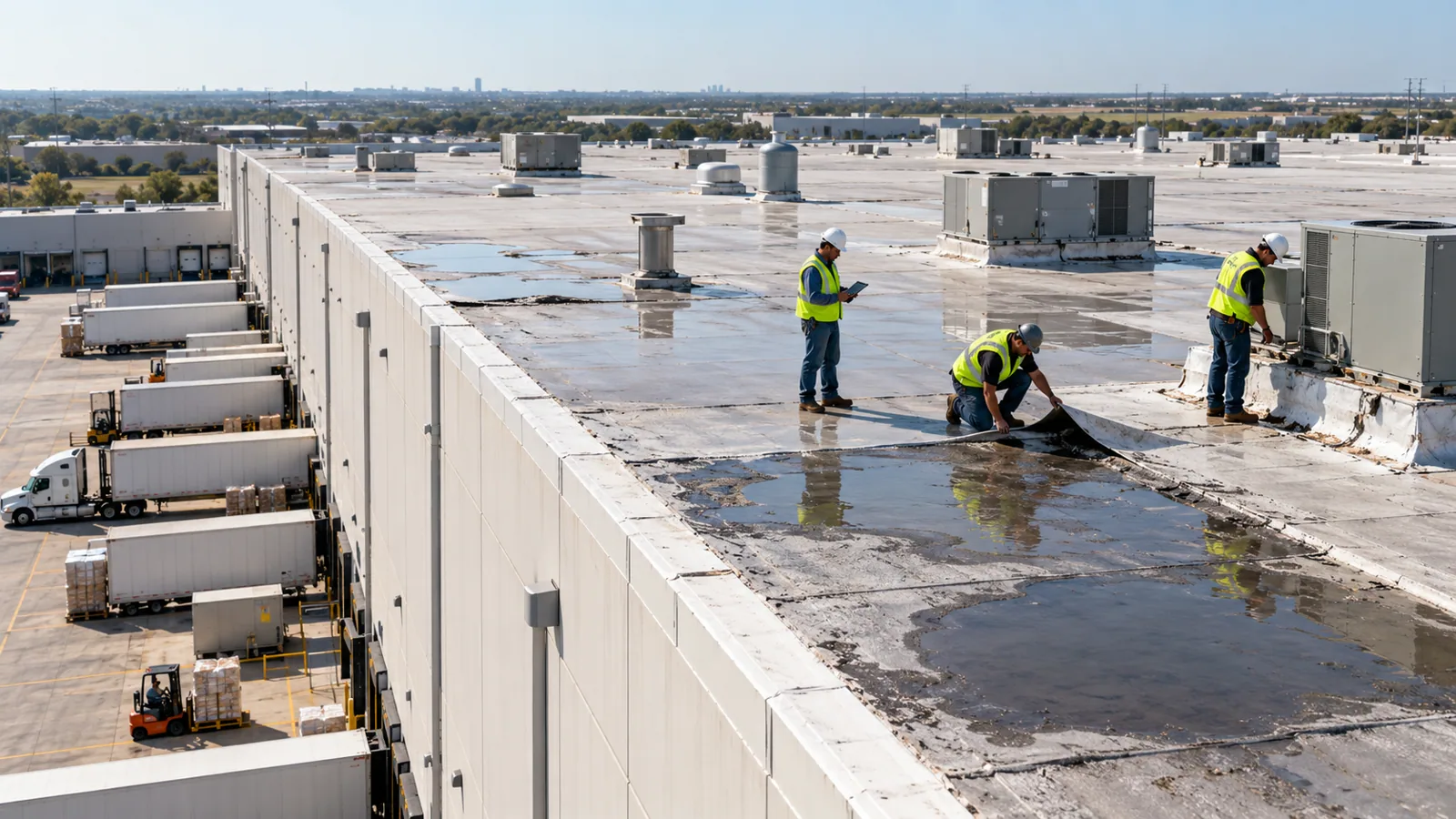
Core cuts reveal the layers hidden below the membrane. We note insulation type, thickness and moisture, then inspect the deck for corrosion, movement or damaged attachment points. Infrared imaging can help direct sampling when conditions are appropriate, but the suspected wet areas still need confirmation. Widespread saturation, trapped moisture or unstable substrate can make an overlay unsuitable because the new assembly would preserve a problem that continues below it. Isolated wet sections may be removed and replaced before the recover, provided the remaining roof meets project requirements. Our infrared moisture survey and selected core cuts give the general contractor a basis for the repair boundary. We record each sample location and finding so the final scope identifies what stays, what comes out and how the transition is closed. If deck work changes after opening, we pause at the affected zone, photograph the condition and confirm the revised scope before covering it.
Added Height and Attachment
New roof layers change the height of the finished surface at every curb, wall, hatch and edge. We check door and equipment clearances, counterflashings, parapet details and the length available for a termination bar. A recover is not ready for pricing until those transitions can be rebuilt without leaving exposed edges or interfering with rooftop service. Fasteners must reach a suitable substrate, and the attachment pattern must match the design conditions rather than assume the old system will hold a new one. Joliet’s building review uses adopted codes with local amendments; commercial projects may require sealed documents and locally determined approvals. We coordinate the assembly description and review path with the project team before procurement. A low-slope membrane such as TPO or EPDM can be considered only after these interfaces are understood. The roof system choice follows the deck, existing layers and perimeter details, not the other way around.
Field attachment tests can clarify whether the deck and existing assembly accept a recover fastener at the required depth. We inspect representative locations rather than infer the substrate from a roof drawing alone. The fastening plan also has to account for board joints, perimeter zones and areas where rooftop traffic concentrates. At walls, pipe supports and equipment curbs, the new membrane needs a clean termination that can be inspected and maintained. We list those details separately because their labor and material can differ from the open roof field. This review gives the estimator a more reliable work sequence and helps the owner understand why a recover bid may include selective removal even when most of the existing surface remains in place.
Drainage, Snow, and Heat
Added insulation or cover board can alter slope near drains and create new low points. We check drain bowls, scuppers, overflow routes and tapered transitions against the proposed finished elevations. Snow and freeze-thaw exposure in Joliet make standing water a practical concern because ponding can stress seams and conceal a slow leak during the next inspection. Summer heat also affects membrane movement and flashing at equipment curbs. Minooka, Shorewood and Joliet lay along a tornado track in July 2023, while hail and wind caused damage across the I-80/Kankakee River Valley. Before leaving existing layers in place, we inspect perimeters, seams and flashings where storm exposure could have altered attachment. That history supports a close review of edges and rooftop attachments, while the individual roof still determines the scope. If drainage issues need a distinct scope, drain and scupper repairs can be coordinated before the new surface closes the assembly. We identify outlets and overflow paths on the roof walk, then compare them with the recover detail so the overlay does not bury access or reduce flow.
Phasing Without Hiding the Scope
A recover may reduce demolition, but the crew still needs a safe staging zone and reliable dry-in points. We divide the roof into sections that can be prepared, attached and sealed within the available work window. At Joliet and nearby Elwood, freight and intermodal access can keep loading activity central to an owner's schedule. We coordinate deliveries, crane picks and rooftop unit work with the general contractor, then keep open areas limited to what can be secured before weather changes. The bid should distinguish preparation, wet-area removal, insulation corrections, membrane attachment and new edge work. That separation keeps a recover from turning into an unpriced tear-off when a hidden condition appears. We also note how roof access affects tenants, maintenance staff and other trades. Closeout includes photographs of transitions, drains and repaired areas, plus a record of any concealed condition that changed the planned work. We coordinate roof walks and deliveries for properties in the Elwood commercial roofing area, while building-specific access still sets the work sequence.
Commercial Roofing Questions
When is an overlay a reasonable alternative to tear-off?
A recover is worth pricing when the existing assembly is dry enough, securely attached, structurally suitable and compatible with the proposed system. We verify those conditions with roof observations, core samples and deck review, then check code and transition details. If moisture is widespread or the substrate cannot support the attachment, removal may be the clearer scope.
Can a second roof layer cover isolated wet insulation?
Wet material should be located and removed before the new surface goes down. We mark each affected area, replace unsound insulation as specified and close the repair boundary so water cannot travel beneath the overlay. Core findings also tell us whether the wet area is local or part of a broader drainage or seam failure.
Will an overlay affect rooftop equipment or parapet details?
Additional height can change curb clearances, counterflashing and perimeter termination. We measure those conditions and identify where equipment trades, taller curbs or rebuilt flashing are needed. A scope that leaves those interfaces vague risks rework after the new field membrane is installed.
Does Joliet code review allow a commercial roof recover?
The assembly must meet the applicable code and local review requirements for the project. We confirm the existing layers, proposed insulation and attachment approach with the design team, then coordinate required documents and approvals before ordering material. Approval cannot be assumed from the fact that an overlay was used elsewhere.
How can a recover be phased around warehouse deliveries?
We set roof sections, staging points and dry-in limits with the general contractor before work begins. Joliet’s freight-oriented operating area makes truck access and loading windows important schedule inputs. The plan should also identify crane placement, unit shutdowns and the time when each section can safely return to service.
Check the Assembly Before Choosing a Recover
Arrange a roof walk and core review with our team. We will document moisture, attachment, drainage and transition heights so the overlay and tear-off options can be compared on the same field conditions.
