Commercial Roofing Services
ROOFING SERVICES
Commercial Roof Leak Repair
Emergency Commercial Roof Repair
Commercial Roof Repair
Commercial Roof Inspection
Commercial Roof Maintenance
Commercial Roof Coating
Commercial Roof Replacement
ROOF SYSTEMS
TPO Roofing
EPDM Roofing
PVC Roofing
Modified Bitumen Roofing
Standing Seam Metal Roofing
PROPERTY TYPES
Warehouse Roofing
Distribution Center Roofing
Office Building Roofing
School Roofing
INDUSTRIES
DAMAGE REPAIR
CAPABILITIES
MANUFACTURERS
SERVICE AREAS
Commercial Roof Leak Repair in Joliet, IL
Commercial Roofing Services
Stop active commercial roof leaks in Joliet with water tracing, temporary dry-in, repair documentation and a plan that protects the occupied space below.
Commercial Roof Leak Repair
A drip above a Joliet production floor changes the work sequence before anyone reaches the roof. We first help control water inside, protect equipment and stock, and identify whether the leak is active or the result of earlier moisture. Then we trace the likely path across seams, curbs, wall transitions, drains and penetrations. The point where water appears indoors may be separated from the opening by insulation or a deck flute, so the repair boundary comes from roof evidence rather than the ceiling stain alone. We document the surface condition, test suspect details and establish temporary dry-in when permanent work cannot safely proceed in current weather. Joliet sees 125.8 annual days with minimum temperatures at or below freezing and 16.9 inches of snow on average, putting drains and flashing transitions on the leak checklist. Nearby freight and manufacturing operations add a practical need to protect loading and production schedules. A focused commercial roof repair can stop the path while preserving the details needed for a permanent scope.
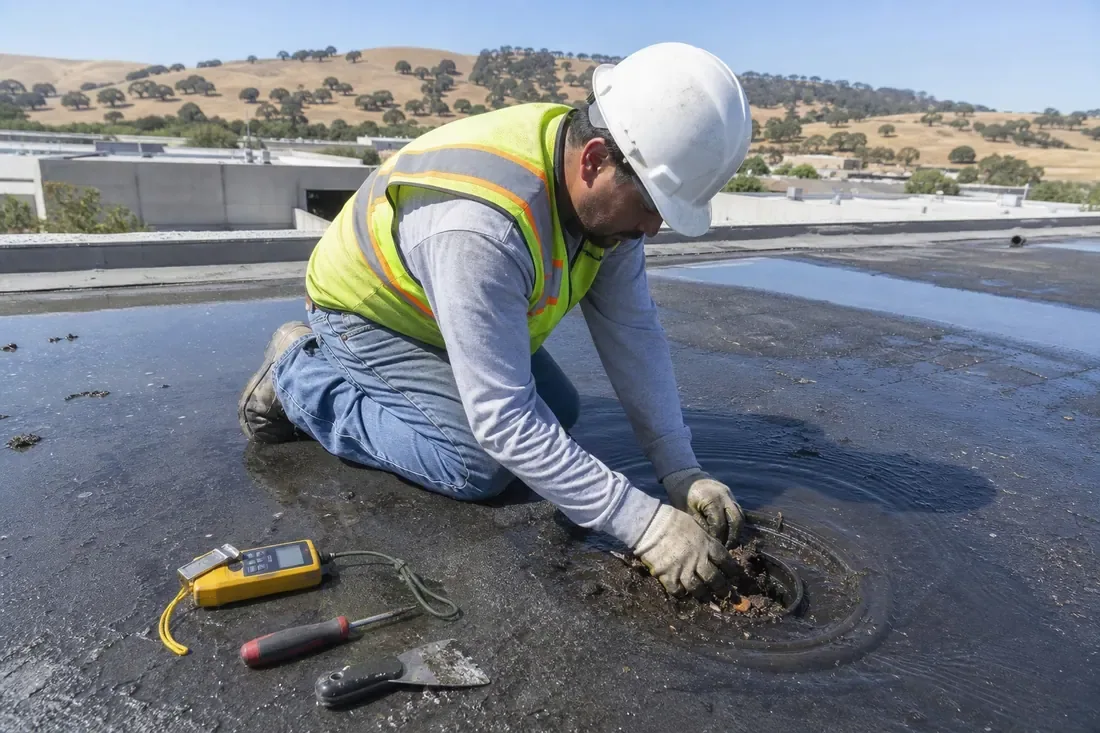
Control Water Before Opening the Assembly
A July 2023 tornado moved from Minooka through Shorewood to Joliet, while damaging hail and wind were reported in the I-80 and Kankakee River Valley area. That regional event may prompt a timely inspection, but it cannot locate a roof opening at a particular address. After an event, we compare the reported leak with the roof zone above it, inspect nearby curbs and drains, and record whether the edge or membrane shows fresh disturbance. Every repair starts with the observed water path rather than a regional damage assumption. We also note whether a temporary measure needs monitoring before a permanent crew returns, and match closeout photographs to the repair boundary shown in the estimate. Our emergency roof response is available any hour, including nights and holidays, when water control cannot wait for a regular schedule.
Follow the Water Path
Once access is safe, we work from the reported interior point toward roof conditions that could explain it. A drain backup can push water toward a seam; a loose pipe boot can admit water that travels beneath the membrane; a failed curb flashing may wet insulation beyond the visible opening. We check membrane laps, fasteners, termination bars, counterflashing and transitions from old repairs. Moisture readings can show where to investigate, while selective openings confirm whether insulation or deck needs attention. We mark findings on photos or a roof sketch so the repair is tied to its location. On low-slope roofs, wind-driven rain can enter at a detail without a broad membrane failure. On metal roofs, fastener movement and panel joints may need a separate inspection. When moisture distribution is uncertain, an infrared survey with core verification can help define the affected area. A loose flashing termination can be addressed through flashing failure repair when the adjacent membrane remains sound. If the installed field is EPDM, we use compatible repair materials and prepare the seam for a durable splice. We do not extend a patch just because a stain is large; we extend it when the field condition shows that the path continues.
Permanent Repair and Interior Return
The permanent repair starts after the affected area is dry enough and the weather window supports the material. We remove loose or contaminated material, prepare the substrate and install a system-compatible patch or flashing detail. If a wet insulation pocket is found, we remove it to a stable boundary and restore the assembly before closing the membrane. A repair that needs to wait for compatible materials or dry conditions remains documented as temporary until the permanent work is complete. We confirm drain flow, seal edges and check nearby transitions so water is not redirected into another weak detail. Joliet averages 14.9 days each year with highs at or above 90°F; the recurring freeze cycle makes surface preparation and material handling part of the repair schedule. The roof record distinguishes initial response, permanent correction and any open follow-up. For repeat leaks or a roof with several aging details, a hands-on roof inspection can help decide whether a repair program or larger renewal scope makes sense.
We also verify whether insulation can dry or must be removed, whether the drain has a clear path, and whether a roof penetration is properly supported. Those checks keep a visible leak from being treated as an isolated membrane defect when another condition is feeding the same area. The work order names each repair item and the test or observation used to close it.
Access, Dry-In, and Documentation
Leak work often happens while the building remains open. Freight clusters give the Elwood/Joliet subregion a critical transportation role; at those properties, we set staging around the loading plan. We coordinate the ladder or lift location, roof route, work window and interior protection with the general contractor or facility contact. If production must pause beneath an opening, we define the hold point before removing material. When the roof can be secured but not permanently repaired, the dry-in is photographed and the return condition is written down. A completed leak report records the entry point, water path, materials used, and any wet insulation or deck issue that remains for a separate decision. That record helps distinguish a repaired leak from moisture that was already present. For leak response across the Joliet service area, we coordinate roof access with the property contact and protect the active space below. Where the finding points to recurring drain issues, drain and scupper service can address the outlet detail as part of a coordinated repair plan.
Commercial Roofing Questions
Why can water appear far from the roof opening?
Insulation joints, deck flutes and framing can carry water away from a seam or penetration before it reaches the ceiling. We inspect above and around the indoor report, then use moisture readings or a selective opening to confirm the path. The repair follows the exposed condition, not the location of the stain by itself.
What happens during an emergency leak call?
We first address safety and interior protection, then assess roof access and weather conditions. The crew can install temporary dry-in or another appropriate water-control measure before permanent materials are available. We record the protected area and next step so the facility contact knows what is secured and what work remains.
Can you make a permanent repair during rain or snow?
The surface and temperature have to support the chosen repair material. When active weather prevents that preparation, we control water with a temporary measure and schedule permanent work for a suitable window. The report keeps those two tasks separate and states the return condition needed to close the repair.
How do you know if insulation needs to be removed?
Moisture readings and core samples help identify whether water has reached the insulation and how far it extends. We mark the limits, remove material that cannot remain in the assembly and inspect the deck before rebuilding the area. A localized finding does not automatically mean the entire roof needs replacement.
What information should the facility provide when reporting a leak?
The room or roof area affected, when water appears, recent weather, any equipment or stock at risk, and prior repair locations help us prepare. Photos of the interior condition are useful, but we still verify the roof details directly. That information helps coordinate access and interior protection before the crew arrives.
Trace the Leak and Set the Dry-In Plan
Call our team to describe the affected area and operating constraints. We will review access, protect the space below, and document the repair path and return work needed to close the roof.
